Contained tablet transfer for blister packaging and counting lines
EXECUTIVE SUMMARY
- Containment: A pharmaceutical machine builder integrated ASBV-AE active valves and ASBV-PS passive valves to achieve contained tablet transfer to blister packaging and counting lines, meeting ATEX Zone 22 internal classification throughout.
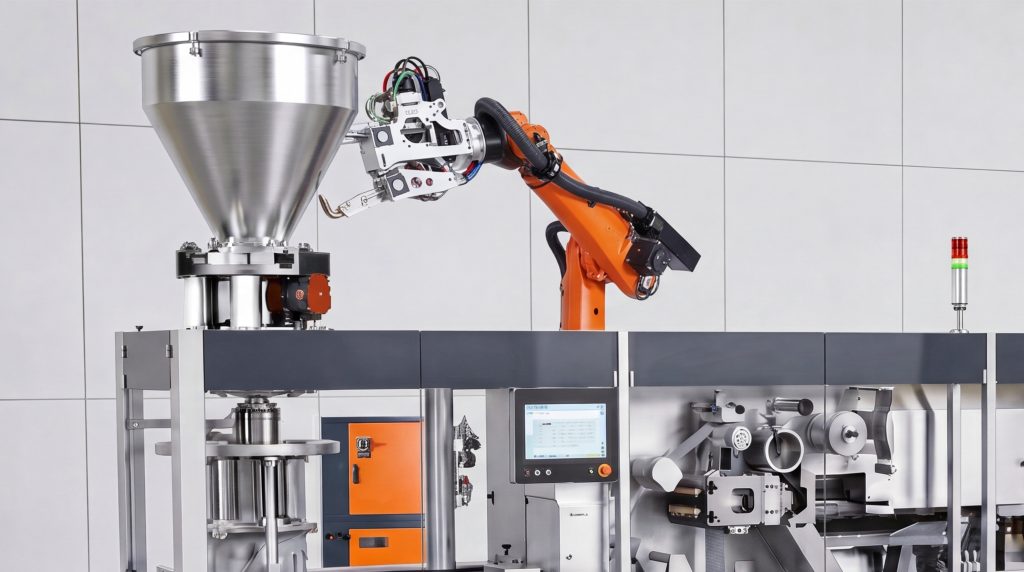
- Configuration: Two active valves on the machines and three passive valves on IBCs (intermediate bulk containers), with a lifting device handling vertical docking. Floor space and alignment repeatability were the critical constraints.
- Washing: Two ASBV-PW passive washing valves were included to clean the active stations in place, eliminating the need to dismantle the process connection for routine maintenance.
| Industry | Pharmaceutical manufacturing (OSD) |
| Process step | Bulk tablet discharge to blister packer and tablet counting machines |
| Product handled | Finished tablets (solid-dose forms; API name not disclosed) |
| Exposure category | OEL < 1 µg/m³ |
| Location | Eastern Europe |
Project Requirements
A pharmaceutical machine builder was designing equipment to handle bulk tablet transfer from intermediate bulk containers (IBCs) into blister packaging and tablet counting machines. The end customer required ATEX certification for the internal zone: Zone 22, which covers explosive dust atmospheres that are not expected during normal operation but may be present for short durations. The external operating environment remained non-hazardous. This combination placed precise requirements on seal materials and actuator design before a single valve was specified.
The project added complexity through its loading geometry. IBCs fitted with passive valves would be lifted by a dedicated lifting device and positioned above the machine discharge points. Alignment repeatability between the IBC and the fixed machine valve was therefore determined by the lifting system, not by manual positioning. The containment interface had to accommodate mechanical offsets introduced by the hoist cycle without operator adjustment.
Primary engineering and operational challenges:
- ATEX compliance with correct seal specification: Zone 22 internal classification required ATEX-certified valves with black EPDM seals. The initial drawing issued with white EPDM had to be corrected and re-approved before production could begin. Seal color and ATEX category must be confirmed at inquiry stage, not during drawing approval.
- Hoist-based docking alignment: The lifting device controls vertical positioning of the IBC. Any variation in hoist repeatability translates directly into misalignment at the valve face. The ASBV-AE was specified to address this, with its Eladur flexible compensation unit absorbing axial offsets of up to ±8 mm per docking cycle.
- In-place cleaning of active stations: With the active valves mounted permanently on the machines, manual disassembly for routine cleaning was operationally impractical. The machine builder required a washing solution that could clean the active valve seat in place, integrated into the same valve interface.
Solution
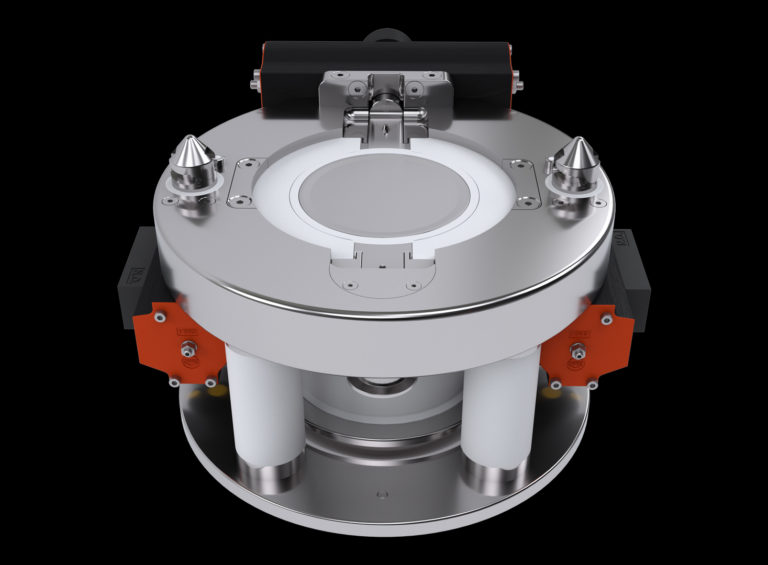
ASBV-AE active valve with Eladur compensation, ASBV-PS passive valve, and ASBV-PW passive washing valve
Andocksysteme supplied two ASBV-AE active valves mounted to the blister packaging and counting machines, three ASBV-PS passive valves fitted to the IBCs, and two ASBV-PW passive washing valves dedicated to cleaning the active stations. All components were specified with black EPDM seals and ATEX Category 3 certification for Zone 22 internal use.
- Eladur tolerance compensation for hoist-based docking: The ASBV-AE includes a proprietary Eladur flexible device that compensates for axial misalignment between the IBC and the machine discharge. When the lifting device lowers the IBC onto the active valve, the Eladur unit absorbs positional variation from the hoist cycle, up to ±8 mm, without requiring manual realignment. Docking is controlled and repeatable regardless of minor variance in hoist positioning.
- Sensor-confirmed docking detection: Two Position Sensors per active valve confirm that the passive valve has docked correctly before the valve opens. This prevents premature opening and provides the machine control system with a verified docking signal, supporting automated sequence control on the packaging line.
- ASBV-PW passive washing valves for in-place active station cleaning: The two ASBV-PW units dock to the active valve flanges and direct a cleaning circuit through the active valve seat and bellow. This eliminates the need to remove the active valve from the machine for routine cleaning. The machine builder retains responsibility for cleaning validation documentation under GMP requirements. For a production environment where machine downtime directly affects packaging throughput, in-place washing is an operational requirement, not an enhancement.
Benefits
The installed configuration gave the machine builder ATEX-compliant contained transfer from IBC discharge through to the blister packer and counting machine hoppers, with automated docking verification and in-place washing built into the interface.
- ATEX-compliant transfer throughout the production zone: All valves carry ATEX Category 3 certification for Zone 22 internal duty. Black EPDM seals on both active and passive valves meet the anti-static requirements for dust-generating solid-dose environments. No additional ATEX-rated enclosures or engineering controls were required at the transfer interface.
- Contained transfer at OEL < 1 µg/m³: The ASBV docking sequence (align, couple and lock, open, transfer, close, unlock, undock) keeps both valve discs sealed against each other at every stage of connection and disconnection. No powder is released to the operating environment during docking or undocking. Containment performance is validated per the ISPE SMEPAC protocol to OEL < 1 µg/m³.
- Alignment accommodation without manual intervention: The Eladur unit on each ASBV-AE absorbs positional variation from the lifting device. Operators do not adjust the IBC position manually between batches. Docking is confirmed by sensor, not by visual check, removing a source of operator-dependent variability from the packaging line.
- In-place washing eliminates active station disassembly: The ASBV-PW washing valve connects to the active station without removing the valve from the machine. Cleaning cycle time and maintenance complexity are reduced. Operational improvement confirmed; specific throughput metrics not disclosed.
Conclusion
The installed ASBV configuration met ATEX Zone 22 requirements, absorbed hoist-based docking variation through the Eladur compensation unit, and supported in-place cleaning via the ASBV-PW, all within the standard ASBV product family.
ATEX compliance followed from seal material selection and certified valve configuration. Docking repeatability was addressed by the Eladur unit rather than by tightening hoist tolerances. In-place cleaning was enabled by the washing valve, which docks to the same active flange used for production transfer.
For machine builders designing solid-dose packaging equipment where dust control, ATEX compliance, and production uptime are concurrent requirements, the ASBV system provides a validated, documentable containment interface. To discuss mechanical integration requirements, contact the Andocksysteme project team for support from drawing approval through 3D file delivery and GMP documentation.
Video presentation
Talk to our Containment Technology Specialists: