Flexible isolator containment:
charging and recovery without breaking OEL <1.0 µg/m³
Summary
- The exposure point is the transfer port: A flexible isolator encloses the operation, but material still has to cross its wall. Charging and recovery are make-and-break events, and that is where a compound with an exposure limit below 10 µg/m³ reaches the room.
- A single-use containment interface on a single-use enclosure: The isolator gets a mechanical containment boundary where material crosses its wall: the AVAX DN100 split butterfly valve, validated to OEL < 1.0 µg/m³ in testing per the ISPE SMEPAC protocol. Its 4 inch Tri Clamp interface per BS 4825-3 mates with the standard hygienic connections isolator builders already use.
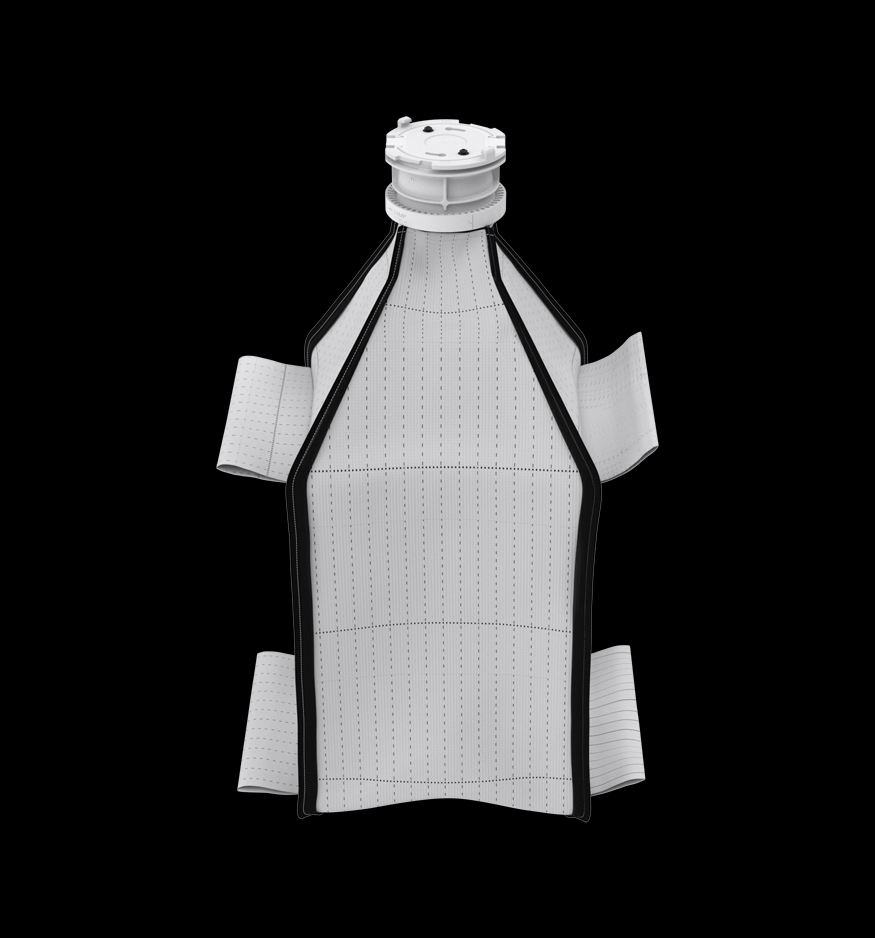
- The transfer is only complete with the container: ACUBE is the AVAX Pharma interface installed on a disposable PE liner, from 0.5 to 400 L. Powder, granulate, and tablets reach the isolator contained and leave it contained.
| Industry | Pharmaceutical solid dosage, API handling, R&D and pilot manufacturing |
| Process Step | Charging into and recovery from a single-use flexible isolator: dispensing, blending trials, milling, sampling |
| Product Handled | Potent APIs, blends, granulates, tablets |
| Exposure Category | OEL < 1.0 µg/m³ |
| Location | Application study, concluded in Spain |
Application Study
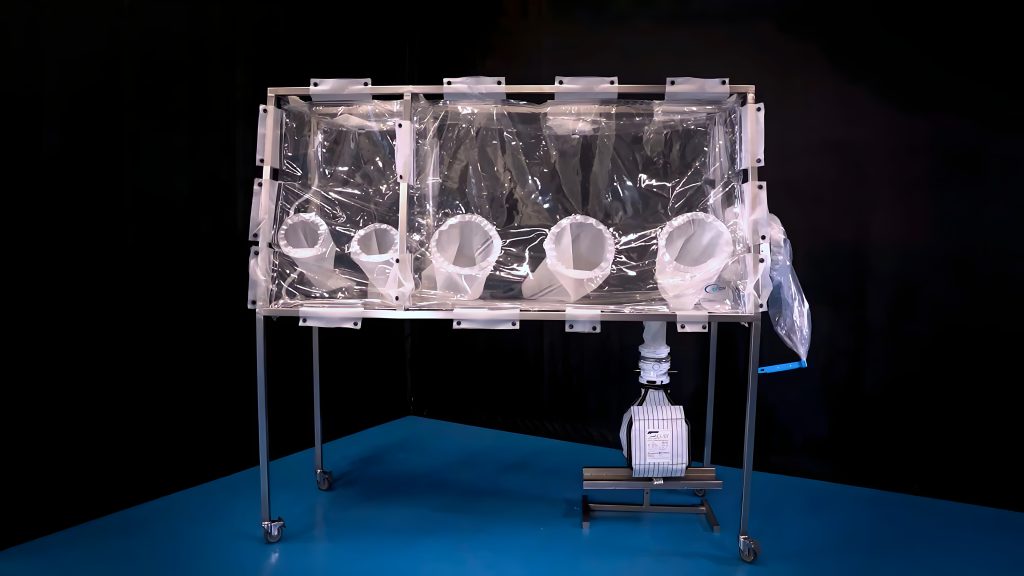
Flexible isolators put a containment barrier around an operation without rebuilding the room, installing around equipment already standing on the floor and folding flat when the campaign ends. Built to the process rather than the process to them, they cost a fraction of a rigid isolator’s capital price.
In solid dosage production they carry dispensing and weighing, blending trials, milling, reactor charging, and the sampling that releases a batch. For potent compounds that means exposure limits of 10 µg/m³ and below. They enclose the operation but not the transfer.
Typical requirements:
Every charge is a make-and-break event: Material has to cross the isolator wall to reach the gloves. A sleeve and tie, a zipped pass box, or a bag-in port puts the containment boundary in the operator’s hands. The barrier is then only as good as the technique used.
The isolator is disposed of with residue inside it: Internal decontamination, collapsing the film, and folding the isolator all happen with product still present. The transfer port has to stay closed through that sequence, or residue leaves the film while it is folded.
Recovery is the same problem in reverse: Finished blend, drawn samples, tablets, and reject material all have to leave. A continuous liner handles waste well, but material returning to the process has to be opened again downstream. Each extra step adds an exposure point to a workflow that exists to remove them.
Solution
Andocksysteme delivers the connection between process units, not the units themselves, and engineers each port to the isolator it serves. Every flexible isolator is drawn around a specific process, room, and operator sequence, so the port has to match that isolator’s film, frame, and working height.
The objective is a mechanical containment boundary at the isolator wall, closed before the operator touches it and closed again before anything is removed.
Closed at both ends: AVAX is a passive-passive split butterfly valve. Both discs stay closed during docking, open together once the bayonet closure is made, and close again before separation. Docking is a single rotation, and one operator completes it working alone.
A single-use interface on a single-use enclosure: The valve’s plastic half is discarded with the isolator, which takes cleaning validation off the transfer port.
The air the powder displaces: Charging a container into an isolator pushes out its own volume of air, and that air needs a filtered route out. Using the The AVAX Filter variant allows the air also to leave the isolator, containing the particulates inside.

Benefits
Sampling without opening the isolator: The ACUBE Sampler could carry a 700 mm or 1500 mm HDPE lance through the same interface, and the AVAX receptacle variant draws a 0.5 L sample directly.
Containment at the material transfer: The AVAX single-use valve together with the ACUBE SL or DL containers, are each validated to OEL < 1.0 µg/m³ in testing per the ISPE SMEPAC protocol.
One interface from a sample to a full batch: ACUBE runs 0.5 to 25 L as a single liner and 10 to 400 L as a double liner.
Disposal stays closed: The valve is closed before undocking, so the isolator can be decontaminated internally, collapsed, and folded with the transfer port sealed.
Conclusions
The OEL < 1.0 µg/m³ figure in this application belongs to the valve on the isolator wall. It applies to the moment material crosses that wall, which is the operation an isolator rating leaves out.
The fit around the AVAX valve decides the project: the bracket that holds it to one specific isolator, the venting for the volume a charge displaces, and the container size that matches the batch. Andocksysteme settles these points with the isolator builder during design.
For a flexible isolator handling potent material, specify the transfer port with the isolator, not after it. Contact Andocksysteme to configure the interface for your process. CSV Life Science Ibérica, the Andocksysteme partner for Spain and Portugal, contributed the field experience with flexible isolator and AVAX configurations that shaped this application study. Thanks also to Servolift LLC in the United States for also contributing to this Application Study.