Split butterfly valve docking across a floor slab in an automated OSD plant
KEY TAKEAWAYS
- Interface: A dozen docking stations connect stainless steel intermediate bulk containers (IBCs) to the process machines above them.
- Engineering: The active valve travels more than two meters down to the IBC inside a compressible sleeve that carries containment through the ceiling penetration.
- Partnership: Andocksysteme was in the project at scope definition, 10 months before the purchase order, and the same passive valve was still the reference part in a customer inquiry six years later.
| Industry | Pharmaceutical manufacturing (OSD) |
| Process step | Contained powder transfer across sieving, blending, compaction, compression, weighing, coating, and IBC washing |
| Product handled | Potent active pharmaceutical ingredients (APIs) in OSD production |
| Exposure category | Containment below 1 µg/m³ (ISPE SMEPAC) |
| Location | Germany |
Project Requirements
The plant put the material and the machines on different floors. The Stainless Steel IBCs stand on the lower level. The process equipment runs above. Product has to cross a Good Manufacturing Practice (GMP) floor slab without opening to either room. The building shell was already designed when the interface was engineered, so the transfer had to fit the architecture rather than the reverse.
Primary engineering and operational challenges:
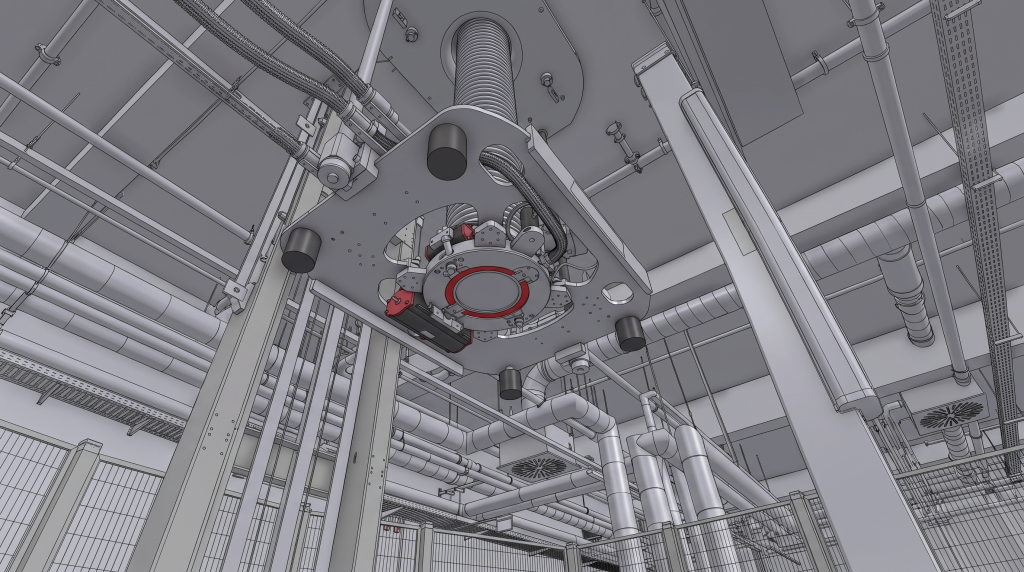
The docking point is not fixed: The IBC is not carried up to the machine. It is delivered below the station, so the valve interface itself has to travel vertically and then dock.
The building set the aperture: The ceiling penetrations were dimensioned before the equipment.
Automated handling sets the tolerance: Automated guided vehicles (AGVs) position the IBCs, cycle after cycle, for the life of the line. The interface has to absorb alignment every cycle. No operator corrects it by hand.
Solution
Andocksysteme was in the project from the first scope discussion, 10 months before the order arrived. The ceiling apertures and the IBC handling concept were set by others, so the engineering task was to build a contained interface that fit constraints it did not control.
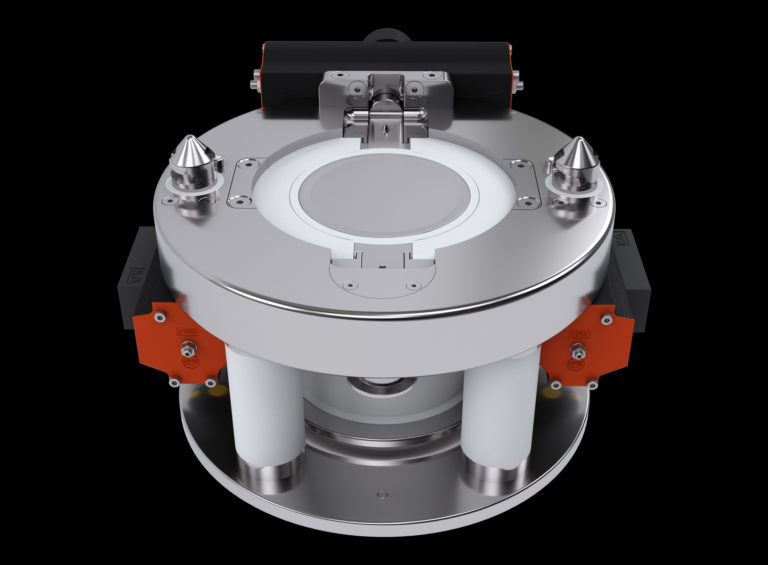
The ASBV DN250 travels to the IBC: Docking no longer depends on the IBC arriving at an exact height. The active half hangs on a lifting frame driven by a multi-stage telescopic cylinder with more than two meters of stroke, and the passive half sits on the IBC.
A compressible sleeve carries the containment: A polyurethane spiral hose with an integrated metal spiral replaced the bellows and compresses 5:1 to follow the full stroke. The contained zone runs unbroken from the production room down to the active valve.
One docking point, two process modes: The same DN250 interface runs a stainless steel lance in one mode and a single-use liner in the other. Andocksysteme did not have to duplicate the valve to serve both ways of working.
Benefits
Acceptance came about 10 months after the purchase order. Closeout followed some six weeks later.
- Containment holds across a building boundary, not just across a flange. Both valve halves stay closed during connection and separation, so the powder path never opens into either room. The ASBV line carries a product rating of OEL < 1 µg/m³.
- The valve absorbs positional tolerance. Because the active half travels and the passive half rides on the IBC, the AGVs have to deliver the IBC to a docking window rather than to a millimeter.
- Andocksysteme designed the cleaning cycle with the transfer. The cycle covers a hose change, evacuation through a filter port, and a cleaning rack collected by an AGV.
Conclusion
A highly automated oral solid dosage plant still comes down to one interface. Where the building forces the transfer across a floor slab and AGVs deliver the IBCs, the split butterfly valve is what holds containment while the geometry moves underneath it.
The configuration is what made that possible: a traveling active valve, a sleeve that compresses to follow it, and one DN250 docking point covering two process modes. Andocksysteme was in the engineering 10 months before the order, and the same DN250 passive valve was still the reference part in a customer inquiry six years later.
The earlier the interface enters a plant project, the less of the building it has to work around. That is the point to bring Andocksysteme in.